
In brief
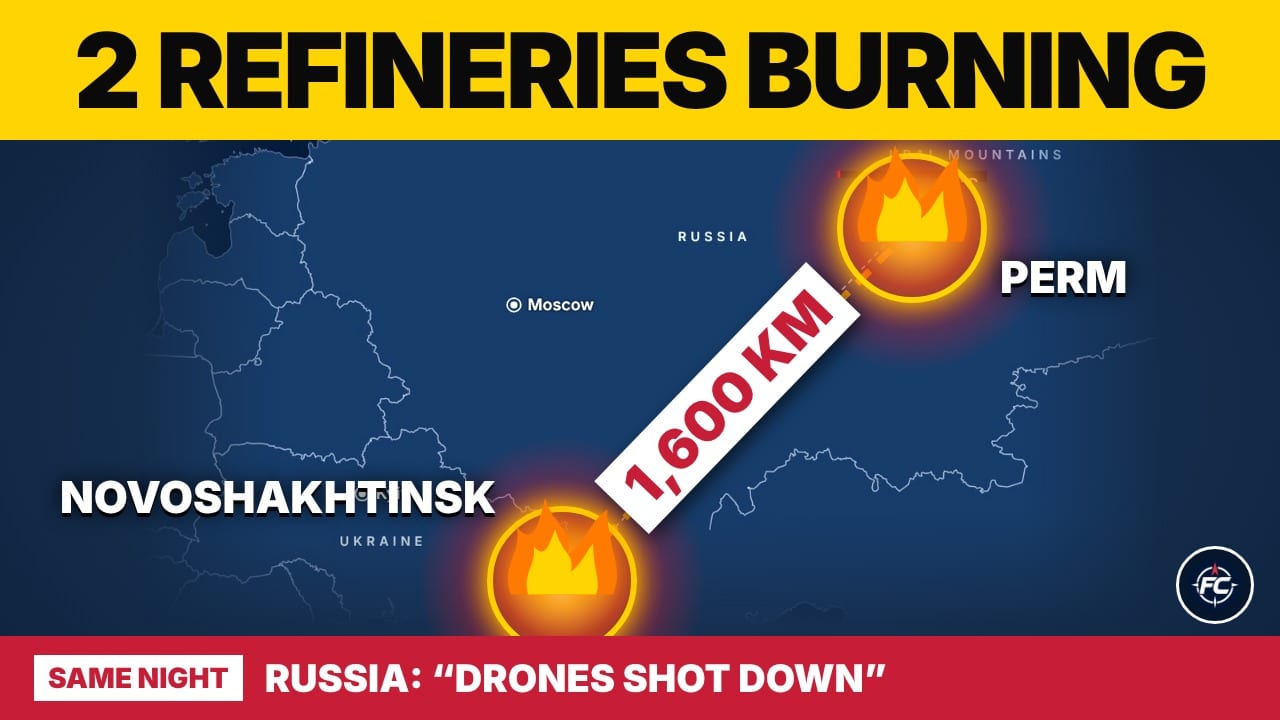
Overnight into Monday, two Russian oil refineries caught fire about 1,600 km apart: Novoshakhtinsk, near the Ukrainian border, and Lukoil's refinery in Perm, at the foot of the Ural Mountains, more than 1,500 km from Ukraine. Both regional governors confirmed fires. Russia's Defence Ministry claims it shot down 192 drones.
Confirmed vs claimed ↓Overnight into Monday, two Russian oil refineries caught fire, about sixteen hundred kilometres apart. One near the Ukrainian border, in Novoshakhtinsk. The other in Perm, on the edge of the Ural Mountains, more than fifteen hundred kilometres from Ukraine. Russian governors confirmed both fires. In Perm, the official explanation was falling drone debris. But these are not random hits. Novoshakhtinsk has now been attacked again and again, and Perm is one of the largest refineries in Russia. And they land in a month when, according to industry sources cited by Reuters, Ukrainian drones have cut Russia’s oil refining by almost half. Today: what happened overnight, why these two plants, what it is doing to Russia’s fuel supply, and what we can confirm, and what we cannot.
Novoshakhtinsk: explosions for hours
Start in the south. At sixteen minutes to one on Monday morning, an air raid alert sounded in Novoshakhtinsk, a mining town in Russia’s Rostov region, close to the border with Ukraine’s occupied Luhansk region. Around one o’clock, residents began reporting explosions. They went on for hours. Ukrainian monitoring channels, Exilenova Plus and Supernova Plus, said the town’s oil refinery was burning. Videos shared by residents show a large fire glowing in the night sky, with air defence audible in the background, and people said the flames could be seen many kilometres away. The Russian outlet Astra reported numerous explosions in the city. By morning, the governor of the Rostov region, Yuri Slyusar, had confirmed a fire at the refinery. Local reports said a storage tank was burning. The extent of the damage has not been independently verified.
Why Novoshakhtinsk matters
Why Novoshakhtinsk? The plant, officially the Novoshakhtinsk Oil Products Plant, can process up to seven and a half million tonnes of oil a year, according to Ukraine’s General Staff. It makes diesel, marine fuel, heating oil and fuel oil. And Ukraine’s military says it is directly involved in supplying Russia’s armed forces, including diesel and aviation fuel for the army fighting in Ukraine. Location matters too. The refinery sits only about two hundred kilometres from territory controlled by Ukraine, in the region that feeds Russia’s southern front. Fuel refined here does not have far to travel to reach the front line. That makes it one of the most valuable fuel targets in southern Russia, and one of the easiest to reach.
Hit again and again
And that is why it keeps getting hit. According to a list compiled by Ukrainska Pravda, the refinery was attacked in June 2022, in May 2023, three times in 2024, in March, June and December, twice in 2025, in August and December, and twice already this year, on the twenty-fifth of August and on the twenty-fifth of September. On that September night, Ukraine’s leadership said two refineries were struck at once: Perm and Novoshakhtinsk. Two months later, the same two plants are burning on the same night again. That is the pattern of this campaign. It is not one spectacular strike. It is coming back, repeatedly, before repairs are finished, so that a refinery that restarts is hit again.
Perm: “industrial facility” damaged
Now, Perm. Here the drone alert came much later, at six thirty in the morning, local time. Soon afterwards, the governor of the Perm region, Dmitry Makhonin, said air defences were repelling a drone attack and that an industrial facility had been damaged, with no casualties reported. He said the fire was caused by falling drone debris. The independent Russian outlet Astra geolocated footage and said the fire was near the refining units of Lukoil-Permnefteorgsintez, the city’s refinery. The monitoring channel Exilenova Plus described a massive fire, and said several storage tanks may have been damaged. A thick plume of black smoke rose over the industrial zone and could be seen from different parts of the city. The Perm refinery is no ordinary plant. It can process about thirteen million tonnes of crude oil a year, making it one of the largest refineries in Russia, and it is considered one of the most technologically advanced.
More than 1,500 km from Ukraine
Look at where Perm is. It lies on the Kama river, at the western foot of the Ural Mountains, the traditional border between Europe and Asia. It is more than fifteen hundred kilometres from the Ukrainian border, and roughly eleven hundred kilometres east of Moscow. It is a city of about a million people, home to defence plants as well as oil. For most of this war, places like this were considered completely safe from Ukrainian attack. They are not anymore. Notice the timing, too. The alert in Novoshakhtinsk came shortly before one in the morning. The alert in Perm came at six thirty. If the drones that reached Perm were launched from Ukraine, they would have been flying for hours across Russian airspace, past layers of air defence, to reach a target deep in the country’s industrial heartland.
Perm’s “oil rain” in April
And Perm has been here before. On the twenty-ninth of April this year, Ukrainian drone strikes hit the same refinery and a nearby oil pumping and dispatch station that is part of Transneft, Russia’s pipeline monopoly. Several storage tanks caught fire and burned for days. Authorities declared a chemical emergency. Thick black smoke covered the city, residents were told to stay indoors and limit their use of water, and people described what fell from the sky as oil rain, carrying petroleum products over parts of Perm. Seven months later, the same refinery is on fire again. For the people of Perm, the war is no longer something that happens fifteen hundred kilometres away.
Why distillation units are the target
Why do refineries make such good targets? A refinery is a chain of units, and the most important link is at the start: the crude distillation unit, a tall column where crude oil is heated and split into its basic fractions before anything else can happen. If that unit is damaged, everything downstream stops, even if the rest of the plant is untouched. Take Omsk, Russia’s largest refinery. On the sixth of July, long-range Ukrainian drones hit its primary processing area, including a distillation unit that accounted for about thirty-eight percent of the plant’s capacity. The next day, the refinery announced a halt to operations. It was attacked again in October, and for a third time on the eleventh of November. That is the logic: hit the few critical units that are hard and slow to replace, and then come back.
Russia claims 192 drones downed
These two fires were part of a much larger night. Russia’s Defence Ministry said its air defences destroyed one hundred and ninety-two Ukrainian drones over Russian regions between eight in the evening and eight in the morning. In the Voronezh region alone, the governor reported thirteen. Those numbers come from Moscow and cannot be checked, but they show the scale of what is now a nightly operation. And it is not only refineries. Earlier in the week, on the nineteenth of November, drones struck oil storage tanks near Almetyevsk in Tatarstan, about thirteen hundred kilometres from Ukraine. Local authorities confirmed the attack. The target was reported to be the Kaleykino pumping station, a key hub in Russia’s pipeline network that feeds oil into the Druzhba pipeline.
Five of Russia’s largest refineries struck
To understand why Monday matters, zoom out to November. Since the thirtieth of October, Ukraine’s General Staff says its forces have struck the refineries in Omsk, Kirishi, Ryazan, Nizhny Novgorod and Yaroslavl, which it says rank among Russia’s five largest by processing capacity. Omsk, Russia’s largest refinery, is nearly two thousand five hundred kilometres from the front line. Kirishi, near St. Petersburg, processes around twenty million tonnes a year, more than six percent of Russia’s entire refining. In the north, the campaign has also reached the Baltic coast: on the eleventh of November, Ukrainian drones hit the oil export port of Ust-Luga, and Ukraine’s General Staff said five fuel tanks were damaged, the same night the corvette Naro-Fominsk was attacked in the Gulf of Finland. Export terminals matter because a refinery that cannot ship its products has to slow down even if it is undamaged. Saratov was hit on the seventh of November. Ilsky, in the Krasnodar region, on the sixteenth. Our refinery war coverage has followed many of these strikes, and Perm and Novoshakhtinsk are the latest two names on a long list. It makes a real difference to a small, independent channel.
Russian refining down ~45%?
So what is all this doing? On the eighteenth of November, Reuters reported, citing two industry sources, that Ukrainian drone attacks had cut Russian refineries’ combined crude processing by forty-five percent since late October: from more than seven hundred thousand tonnes a day to around four hundred thousand. The attacks had disrupted or halted operations at fifteen refineries. President Zelensky has gone further, claiming that Ukrainian strikes took fifty-five percent of Russia’s refining capacity offline. Not everyone sees it that starkly. Michael Bohnert, an analyst at the RAND Corporation, estimated that Russia was still processing around three point seven million barrels a day, down from a typical prewar rate of five to five and a half million, and close to the three point two to three point eight million barrels needed to cover domestic demand at this time of year. In other words, the estimates differ, but they all point the same way: Russia’s refining system is running far below normal, and close to the edge of what the country itself needs.
Export bans, rationing, ~98 rubles a litre
And Russians are feeling it at the pump. Russia has banned gasoline exports since April, and extended that ban through January. Jet fuel exports have been banned since June. Even so, the national average price of gasoline was about ninety-eight rubles a litre at the start of November, up around sixteen percent since the beginning of the year, according to The Moscow Times. In some regions, Rosneft filling stations limit drivers to thirty litres of gasoline at a time. One of the largest filling station chains in the Moscow region, Trassa, went bankrupt and furloughed around fourteen hundred employees. Wholesale gasoline sales on Russia’s main commodity exchange fell thirty-one percent in a single week after the latest strikes, Reuters reported. And Russia, one of the world’s largest oil producers, has been importing gasoline from countries including Turkey, Egypt and India to fill the gap.
Fuel prices outpace inflation
The shortages are uneven, and that tells its own story. In September, the Kaluga region southwest of Moscow brought back an odd-even system for filling up, based on licence plate numbers, and banned sales into canisters, with fuel reserves expected to last about twenty days. St. Petersburg capped gasoline sales at thirty litres per vehicle. In early November, a Russian newspaper reported rationing in at least four regions, including Zabaykalsky Krai in the Far East, and in the Nizhny Novgorod region all filling stations limited gasoline sales and refused vehicles registered in other regions. The cost is spreading into the wider economy. Between January and September, retail gasoline prices rose by more than twenty-one percent, while overall inflation over the same period was about five percent. The Bank of Russia paused its interest rate cuts, keeping its key rate at fourteen percent, and said motor fuel prices had fed into inflation. And the state is paying oil companies to keep supplying the domestic market: those compensation payments reached about one point two trillion rubles between April and September.
The next pressure point: diesel
The next pressure point is diesel, and winter. Diesel runs Russia’s trucks, its farm machinery, its trains on non-electrified lines, and its army. Russia normally produces far more diesel than it uses, and sells the surplus abroad. That export income now depends on refineries that keep catching fire. According to The Insider, Russia planned to export around two point one five million tonnes of diesel in November, including half a million tonnes under a deal with the United States. Reuters notes that falling refinery output could make it harder for Moscow to deliver on that deal. And a refinery like Novoshakhtinsk, which supplies diesel to the army in the south, is exactly where shortages would hurt the military first.
An energy war before winter
How does Moscow describe all this? Mostly, it does not. Governors confirm fires at industrial facilities and blame falling debris. The Defence Ministry publishes how many drones it says it shot down. The scale of the damage to Russia’s refining is not discussed on state television. Meanwhile, Russia keeps up its own campaign against Ukraine’s energy system. President Zelensky said Russia fired one hundred and sixty-five missiles at Ukraine in a single week, and again urged Washington to approve the transfer of Patriot missiles that Ukraine’s allies have already paid for. He called the delays difficult to understand. Both countries are now trying to break the other’s energy system before winter. The difference is in the targets: Russia is hitting power plants that keep Ukrainian homes warm, while Ukraine is hitting the fuel that keeps Russia’s war machine moving and its export revenue flowing.
How the strikes are carried out
How are these strikes carried out? Ukraine has not detailed this attack. As of Monday morning, Ukraine’s General Staff had not officially confirmed the strike on Perm. Some Ukrainian media reported that the drones used were FP-1s, made by the Ukrainian company Fire Point, a long-range strike drone that has become a workhorse of the refinery campaign. That has not been confirmed. Ukraine also uses the Antonov Liutyi, a long-range one-way attack drone that has been used against refineries hundreds of kilometres inside Russia. These drones are cheap compared with a cruise missile, and Ukraine now produces them in large numbers. That allows it to send dozens or hundreds of them in one night, spread across many targets, forcing Russia to defend thousands of kilometres of industrial sites at once.
Confirmed vs. claimed
So let us separate what we know from what is claimed. Confirmed by Russian officials: a fire at the Novoshakhtinsk refinery, confirmed by the Rostov governor; damage and a fire at an industrial facility in Perm, confirmed by the Perm governor; and a large Ukrainian drone attack overnight, with Russia claiming one hundred and ninety-two drones shot down. Reported by independent analysts, including Astra: that the fire in Perm was at the Lukoil refinery’s processing area. Claimed or not established: how badly either refinery was damaged and how long it will be out of action; which drones were used; and whether any other sites were hit. We will update this as satellite images and official statements appear.
Our assessment
Here is our assessment. First, this is a campaign of repetition, not of single blows. Novoshakhtinsk has now been hit around ten times. Perm twice in seven months. Ukraine is betting that it can hit refineries faster than Russia can repair them, especially while Western sanctions make some imported equipment harder to get. Second, the geography has changed. With refineries burning in the Urals and in Siberia, there is no longer a safe rear in Russia’s oil industry. That forces Russia to spread air defences thinly, away from the front. Third, be careful with the biggest numbers. A forty-five percent drop in refining is an estimate from industry sources, not an official figure, and Russia has buffers: export bans, imports, and stockpiles. A refinery that is hit does not necessarily stop for good. But the trend is clear, and winter will test it. If diesel shortages start to affect the army in the south, the refinery war will stop being an economic story and become a battlefield one.
What to watch next
So what should you watch next? First, confirmation: satellite images and fire data from Perm and Novoshakhtinsk, and whether Ukraine’s General Staff officially claims the strikes. Second, the pumps: new rationing, price caps, or longer export bans, especially the jet fuel ban that is due to expire at the end of November. Third, diesel: whether Russia cuts diesel exports, and what happens to its deal with the United States. Fourth, retaliation: Russia’s next large missile strike on Ukraine’s power grid, and whether Ukraine gets the Patriot missiles it is asking for. And fifth, Perm itself: if the refinery has to shut down, it will be one of the largest Russian plants taken out this winter.
This has been Frontline Compass.
Key Facts — Confirmed vs Claimed
How we label- ConfirmedFire at the Novoshakhtinsk refinery after an overnight drone attack — Rostov governor
- ConfirmedAn "industrial facility" damaged and on fire; officials blame falling drone debris — Perm governor
- ReportedThe Perm fire was near the processing units of Lukoil-Permnefteorgsintez — Astra, geolocated footage
- Claimed192 Ukrainian drones destroyed overnight — cannot be verified — Russian MoD
- Not establishedThe extent of the damage, how long either plant will be offline, and which drones were used
SOURCES
- Perm and Rostov regional governors
- Russian Ministry of Defence (via TASS)
- Astra
- Reuters (18 Nov 2026, citing industry sources)
- Ukraine's General Staff
- Ukrainska Pravda
- Interfax-Ukraine
- Militarnyi
- Kyiv Independent
- The Moscow Times
- The Insider
- RAND Corporation (M. Bohnert)
- Rosstat via Free Policy Briefs
Images: Wikimedia Commons (authors and licences shown on screen); NASA FIRMS fire data (public domain); U.S. Army / DVIDS (public domain). Maps: Natural Earth. Positions and distances approximate.
Spotted an error? Request a correction.